
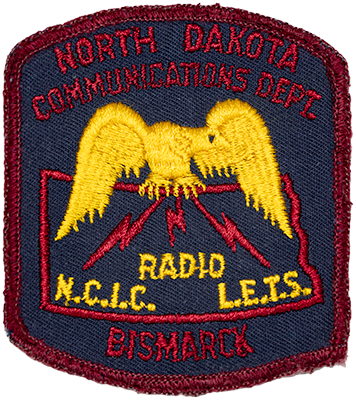
The History of the State Emergency Communications Center
The State Emergency Communications Center, or SECC, was established as the State Radio Broadcasting System in 1951 by the state legislature. Its purpose was to provide state and political subdivisions with an efficient and rapid method of exchanging information statewide and throughout the United States. Initially it dispatched federal, state, and local emergency resources though the use of a network of radio stations. This communications network transmitted aid and facilitated law enforcement activities, disseminated weather information, assisted in making emergency medical care available to state residents, and coordinated disaster control during adverse weather or military emergencies on a 24-hour basis. In addition, the agency maintained a statewide file system to assist law enforcement in the recovery of lost or runaway children and other missing persons.
Over the years, the SECC has evolved to keep pace with advances in technology and the needs of North Dakota and its citizens. The analog radio system was modernized with digital equipment, which is now being converted to the newly constructed Statewide Interoperable Radio Network to provide service across the myriad counties, agencies, and jurisdictions it serves. The SECC continues to add to the counties utilizing its services, with three new counties joining in 2026 and 2027, and is committed to be accessible to all North Dakotans.
The State Emergency Communications Center is headquartered at Fraine Barracks in Bismarck.
Timeline
Upon its inception in 1951, the State Radio Broadcasting System was originally governed by the Board of Administration. The Board, consisting of the Commissioner of Agriculture and Labor, the Superintendent of Public Instruction, and three members appointed by the governor, employed staff responsible for carrying out the duties required of the State Radio Broadcasting System.
In 1969, the Board of Administration was abolished by executive order, and the Director of Institutions replaced the Board as the manager of state institutions. Control of the State Radio Broadcasting System was transferred to the Director of Institutions, and it became known as the State Radio Communications Office. The Director of Institutions appointed the director of the System.
In 1991 the office of the Director of Institutions was dissolved, and the State Radio Communications office became the State Radio Communication Division. It was placed under the supervision the Office of Management and Budget.
In 2003, "State Radio" consolidated with the Division of Emergency Management. The two were combined to establish an integrated state operations center.
In 2005, the State Legislature created the North Dakota Department of Emergency Services. NDDES included the Division of Homeland Security and the Division of State Radio Communications. The Legislature authorized the Adjutant General to create, as needed, one or more advisory committees to the Department of Emergency Services, and in 2007 the Adjutant General was named the director of the Department of Emergency Services.
In 2025, twenty years after the creation of NDDES, the Division of State Radio Communications was renamed by the legislature. "State Radio" became the State Emergency Communications Center, its new name more accurately reflecting its mission and its use of myriad tools and technologies, beyond just radio, to provide effective public safety communications. Bills passed by the 69th Legislative Assembly classified public safety telecommunicators as first responders, allowing them access to vital mental health and disability benefits, and granted them eligibility to join the state public safety retirement plan.
The gallery below contains photos of State Radio staff and equipment from the State Archives.


